
Imagine this scenario: It’s 2:00 PM on a Tuesday. You are a CFO in downtown Kansas City, and you’re trying to finalize a payroll transfer before the 3:00 PM banking cutoff. Suddenly, your screen freezes. The application crashes.
You call your IT support. You get a voicemail. Or worse, you get a polite person who takes your name and says, “Someone will get back to you.”
Thirty minutes pass. The banking deadline looms. You aren’t just frustrated; your business operations are actively bleeding.
This is the “IT Black Hole”—the place where urgent tickets go to die while waiting for the “smartest person in the room” to become available. Many business owners believe the solution to this is simply hiring more people. But in reality, the speed and accuracy of IT support rarely depend on headcount alone. They depend on structure.
To understand why ThrottleNet can offer a 90-second average response time while others leave you hanging for hours, we have to look “under the hood” at the architecture of the help desk: The Multi-Tiered Support System.
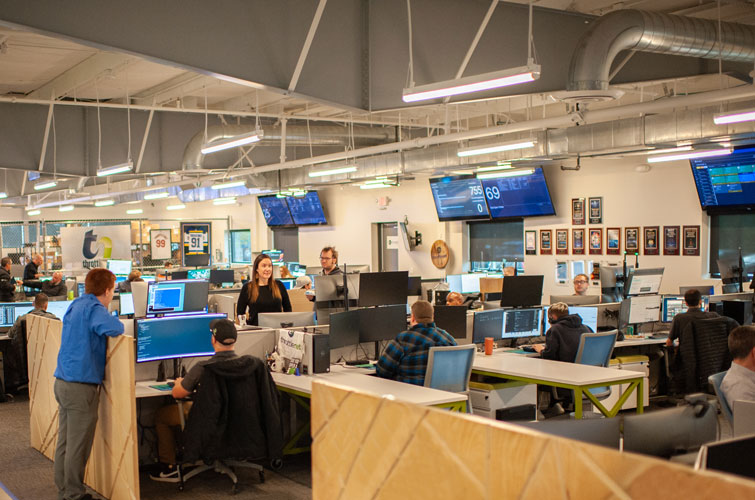
The Emergency Room Analogy: Why Structure Equals Speed
The easiest way to understand a high-functioning IT help desk is to picture a hospital Emergency Room.
If you rush into an ER with a sprained ankle, you don’t want to see the Chief Neurosurgeon immediately. Why? Because while she is brilliant, she is likely in the middle of a complex, life-saving operation. If she stops to wrap your ankle, the patient on the table suffers. Conversely, if you are having a heart attack, you don’t want to be stuck in line behind twenty people with seasonal allergies.
An efficient ER relies on Triage.
- Triage Nurses assess the situation immediately, treating minor issues on the spot and routing critical issues to specialists.
- ER Doctors handle the bulk of serious but treatable conditions.
- Specialists are reserved for the most complex, life-altering cases.
ThrottleNet’s multi-tiered help desk operates on this exact philosophy. It isn’t bureaucracy; it is a rapid-response workflow designed to ensure the right problem gets to the right expert instantly. This structure is the secret engine behind our 93% same-day resolution rate.
Inside the Engine: How the Tiers Actually Work
When Kansas City businesses partner with ThrottleNet, their requests flow through a distinct three-tier system. Here is what happens to your ticket and why this system is faster than the “one guy does everything” model.
Tier 1: The First Responders (Speed & Quick Wins)
The Goal: Immediate response and rapid resolution.
When an alert comes in or a user reaches out, it hits Tier 1 first. These are not “call center script readers.” In a mature MSP model, Tier 1 technicians are trained IT professionals equipped with tools to solve the most common friction points immediately.
Think of password resets, printer mapping connectivity issues, or basic software glitches. These issues make up the vast majority of daily IT headaches. Because Tier 1 is dedicated to volume and speed, they are the reason ThrottleNet maintains a 90-second average response time.
- The Benefit: If your issue is simple, it gets fixed now. You aren’t waiting for a senior engineer to finish a server migration just to unlock your email.
Tier 2: The Detectives (Analysis & Deep Dives)
The Goal: thorough investigation and administrative fixes.
Some problems aren’t quick fixes. If a specific piece of software keeps crashing on one computer but not another, or if a user needs complex permission changes within a secure folder, that is a Tier 2 issue.
Tier 2 technicians have deeper access rights and more specialized knowledge. They act as detectives, looking at logs and backend configurations.
- The Benefit: By separating these issues from Tier 1, the “First Responders” don’t get tied up on 45-minute troubleshooting calls, keeping the phone lines open for new requests.
Tier 3: The Specialists (Complex Infrastructure)
The Goal: High-level architecture, server health, and security.
These are the “Surgeons” of the IT world. Tier 3 engineers handle server outages, network-wide security threats, firewall configurations, and cloud infrastructure architecture.
In a poorly run IT department, these highly skilled engineers are constantly interrupted to fix printers or reset passwords. This “context switching” is a productivity killer. In the tiered model, Tier 3 engineers are protected from low-level noise, allowing them to focus entirely on keeping your business infrastructure stable and secure.
- The Benefit: When a critical issue strikes, your top experts are available immediately because they aren’t bogged down with minor tasks.
The “Bottleneck Effect”: Why Flat Support Models Fail
Many small businesses in Overland Park or Lee’s Summit rely on a “flat” support model—either a single internal IT person or a small provider where everyone does everything.
While this feels personal at first, it inevitably creates a bottleneck.
Imagine a single IT manager, “Dave.” Dave is smart and capable. But if Dave is currently rebuilding a crashed server (a 4-hour job), he cannot answer the phone. If five employees get locked out of their accounts during that time, they sit idle for four hours.
In a flat model, accuracy suffers because urgency trumps strategy. Dave applies a “band-aid” fix to the server just to get back to the ringing phones.
In ThrottleNet’s tiered model:
- Tier 1 handles the five employees immediately.
- Tier 3 continues working on the server without interruption.
- Accuracy is maintained because no one is rushing to put out fires outside their lane.
Why This Matters for Kansas City Businesses
For businesses in the Kansas City metro, from logistics companies in Lenexa to law firms on the Plaza, downtime is a revenue killer.
You don’t care about “tickets”—you care about uptime.
The multi-tiered structure is the only way to scale reliability. It transforms IT support from a reactive chaotic scramble into a predictable, process-driven machine. It is the reason why ThrottleNet can support hundreds of businesses and still maintain a customer happiness score of over 98%.
By filtering noise through Tier 1 and Tier 2, we ensure that:
- Simple problems are solved in minutes (not hours).
- Complex problems are solved by experts (not guess-work).
- Root causes are identified and fixed permanently.
Frequently Asked Questions
Q: Does a tiered system mean I get passed around from person to person?
A: No. It means you are routed to the right person immediately. Most issues (roughly 70% industry-wide) are resolved at Tier 1 without ever needing a transfer. If a transfer is needed, it happens instantly behind the scenes with full documentation, so you don’t have to repeat your story.
Q: What if I have a genuine emergency, like a total network outage?
A: The “Triage” concept applies here. High-severity issues are flagged immediately and escalated to Tier 3/Emergency Response teams instantly, bypassing the queue.
Q: Is Tier 1 just an automated bot?
A: At ThrottleNet, absolutely not. While we use AI and automation for monitoring, our help desk is staffed by local, trained human professionals. When you look for support, you are connecting with a person who understands the context of your business.
Moving From “Fix It” to “Prevent It”
The ultimate goal of a multi-tiered help desk isn’t just to fix things faster—it’s to stop them from breaking in the first place. Because the tiered system collects data on every issue, our Virtual CIOs (vCIOs) can analyze trends. If Tier 1 sees a spike in password resets, we can recommend a Single Sign-On solution. If Tier 3 sees repeated server warnings, we plan a migration before a crash occurs.
When you stop fighting fires, you can start building the future. A structured help desk is the foundation that allows you to stop looking at your stopwatch and start focusing on your business growth.