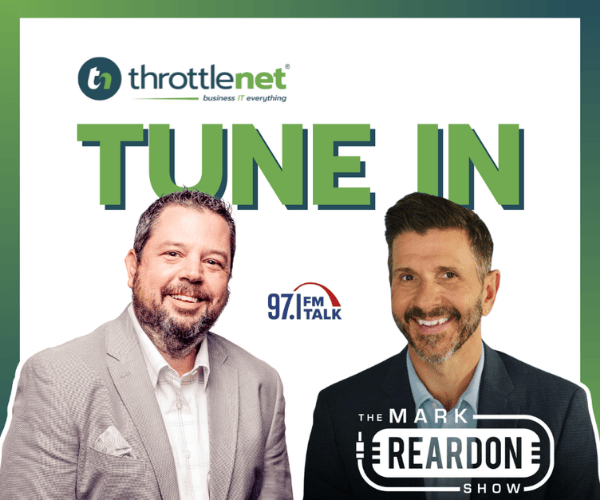
Artificial intelligence can now gauge a cancer patient’s risk of dying just by studying a picture of their face, cybercriminals are sneaking into company AI accounts to rack up bills in the tens of thousands, and Apple has finally joined the smart home race with a $299 hub. During this week’s Tech Talk Tuesday on the Mark Reardon Show, 97.1 FM Talk, ThrottleNet owner George Rosenthal walked through all three stories, explained why each one warrants careful attention, and offered a quick Wi-Fi change that can stop your connected gadgets from exposing your work laptop. Interested in learning more? Continue reading below.
When AI Reads Your Face to Estimate Mortality Risk
The conversation began with a Washington Post article that stunned both George and the host. A research team at Mass General Brigham had already built FaceAge, a tool that judges a person’s biological age from a photograph. Now they’ve created a new foundation model, trained on over 40 million face images, and its latest version, FAHR-FaceSurvival, takes things further: it can forecast a cancer patient’s risk of death directly from a photo.
George described how the system studies the bridge of the nose, the skin beneath the eyes, the temples, and the forehead, looking for indicators of frailty such as lost soft tissue and wasted muscle. Physicians have long known the look of someone who is near the end of life. The surprise here is that AI seems able to catch warning signs much earlier. The researchers trained the model on photos of more than 30,000 cancer patients whose outcomes were already documented, including who survived and, for those who didn’t, how long they lived following diagnosis.
George pointed to one figure from the coverage: among patients in the top 10% risk category, roughly half died within 90 days.
Even so, George didn’t hold back on his worries:
- Insurers. What if insurance companies get hold of these photos and use them as grounds to reject claims?
- Photos at every appointment. What if doctors started capturing patients’ faces at every visit from birth onward, the same way a scale is part of every checkup?
- Wrong predictions and family anguish. What happens when relatives are told a loved one may have only months left and the forecast is mistaken? Might doctors end up ordering needless treatments because an algorithm said so?
- Oversight. George urged lawmakers to examine this right away, while questioning whether legislation could truly prevent harmful uses.
He separated this from other medical applications of AI. Using AI to read a CT scan or MRI is an entirely different matter, he said, from having it evaluate someone’s face and predict their future. In his opinion, that crosses into dangerous territory.
Criminals Are Taking Over AI Accounts and Running Up the Tab
George then explained a notable change in how cybercriminals work. In the past, attackers who broke into a network would lock the files and demand payment. These days, before they do that, they search for the API keys, logins, and passwords connected to the AI services a business or its staff rely on, including ChatGPT, Gemini, and Claude.
The motivation comes down to “tokens,” the units of computing power AI providers charge for. Every request, whether it’s a simple question or a task handed to an AI agent, consumes them. A company may pay a few hundred dollars monthly for an enterprise plan, but a criminal with your credentials can burn through tokens nonstop, using your account to go after other companies or to produce malicious code for ransomware and malware attacks. George shared that some businesses have opened a bill showing $25,000 to $40,000 in charges built up over one weekend, when the normal total would have been about $400.
His suggested safeguards:
- Put hard spending limits in place within the settings of every AI service your company uses.
- Enable billing alerts, either through your bank or the AI provider, so you’re warned about your remaining tokens before extra charges kick in.
- Write an AI use policy. If your team is using a mix of AI tools without clear guidelines, you have no visibility into what’s going on. George compared the importance of an AI policy to protecting against ransomware, and said ThrottleNet can walk businesses through creating one.
Apple HomeView: A Smart Home Hub Without the Ads
On a lighter note, George moved to Apple’s new HomeView, the company’s long-delayed rival to the Amazon Echo and Google Home. The $299 smart display can rest on a counter or hang on a wall like a thermostat, acting as the control center for your house. Pre-orders have started, and it begins shipping November 13.
What George liked best is what the device leaves out. Amazon and Google products frequently serve up shopping prompts and product pitches, but HomeView is built to be free of ads. He also highlighted Apple’s focus on privacy. The hub runs on a redesigned, AI-driven version of Siri, and Apple says requests are processed on the device or through its Private Cloud Compute system. According to George, it will handle the same jobs as an Echo or Google Home, like switching on the TV or lights by voice, while the AI gradually picks up your routines.
For anyone considering a purchase, George shared a couple of tips:
- Check for Matter support. Matter is a shared standard that allows smart devices from different manufacturers to work together. Lights, thermostats, and other gear that lack it might need replacing.
- Think about the devices you already own. George uses Ring cameras, which Amazon owns, and says connecting them to Apple’s hub could require a separate bridge device that runs a couple hundred dollars.
An Easy Wi-Fi Change to Shield Your Work Laptop
George saved his most useful advice for last: move your smart devices onto a guest Wi-Fi network. Cameras, thermostats, refrigerators, TVs, and similar connected products should stay off the network your work laptop uses.
The logic is straightforward. If a hacker gets into one of those gadgets, they won’t have an automatic route to the computer you use for your job. It only takes a few minutes: sign in to your router (whether it came from Spectrum, AT&T, or a store), set up a guest network with a separate password, and switch your smart devices to it.
Both hosts confessed they didn’t know this was possible, which is exactly why George suggests looking into it today.
The Bottom Line
AI is spreading into healthcare, the workplace, and the living room, and every new step brings genuine benefits alongside genuine risks. Cap spending on your AI accounts, establish an AI policy at your company, keep smart devices on their own network, and think carefully about how personal data, even a photo of your face, could be used.
Catch George Rosenthal live every Tuesday for Tech Talk Tuesday on the Mark Reardon Show, 97.1 FM Talk. Have a tech question you’d like answered on air? Reach out to [email protected] or contact us here!